Stop trusting backtests
that look too good.
Find out whether your strategy survives out-of-sample, walk-forward and multiple-testing checks, or whether you just got lucky. One command, plain-English verdict.
Get the kit Free checklist: 7 ways your backtest liesWe backtested 1,000 coin flips on Bitcoin.
Each strategy decided to be in or out of the market at random. Zero skill by construction. Real prices 2018-2026, with trading costs.
Sharpe 1.09
Sharpe 0.65
pass mark is 0.95
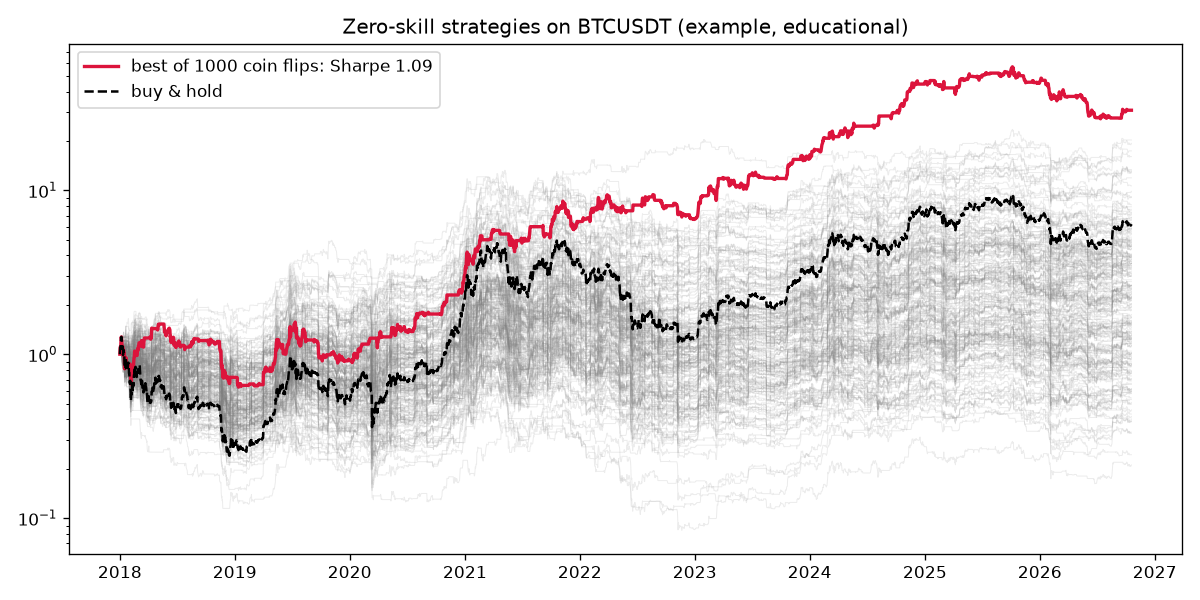
Example on public historical data, educational. Reproduce it yourself: python luck_demo.py --source binance --symbol BTCUSDT --start 2018-01-01
If a coin can do that, so can the strategy you found after 50 tweaks in ChatGPT. The difference is whether you can prove it is not luck.
What is inside
🧪 Python research lab
Tests up to 3,000 strategy configurations (or your own rule) with realistic costs, then runs out-of-sample, deflated Sharpe, neighbour stability, walk-forward and bootstrap tests. Writes a report with a verdict: candidate / weak / reject.🔍 Look-ahead detector
The #1 bug in AI-written backtests: code that quietly uses tomorrow's price. The detector deletes the future and checks whether your signals change. It caught all three classic bugs in our tests.🤖 12 skeptic prompts
For Claude, ChatGPT or Gemini: stress-test an idea, audit code for leaks, interrogate results, plan paper trading. The AI argues against you, not with you.📘 Guide: How Not to Blow Your Account
15 pages: the arithmetic of drawdowns, seven ways backtests lie, position sizing, a paper-trading protocol and a pre-launch checklist.The honest number most tools never show
On BTC + ETH, 1,645 of 3,000 configurations looked good on the history used to build them. None passed every test on unseen data. The best in-sample strategy (Sharpe 1.60) kept about a third of its edge (0.52) out-of-sample.
The kit's walk-forward test re-runs your whole selection method year by year on data it has not seen and compares it with buy & hold:
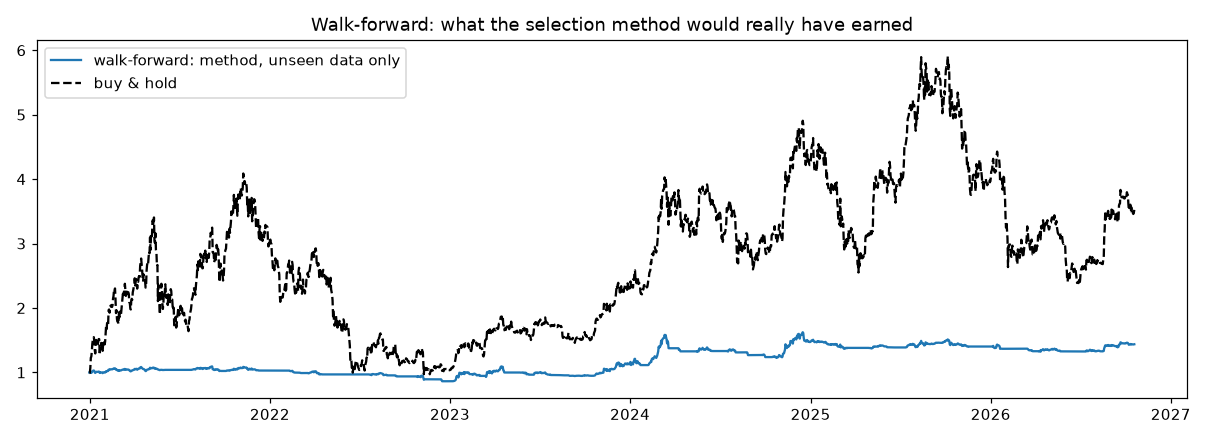
Example on public historical data. Past results do not predict future returns.
How it works
pip install -r requirements.txt
python research.py --symbols SPY QQQ IWM                  # stocks / ETFs
python research.py --source binance --symbols BTCUSDT     # crypto
python lookahead_check.py my_strategy.py                  # catch future leaks
python research.py --custom my_strategy.py --symbols SPY  # test YOUR rule
| Markets | Stocks, ETFs, indices, forex, futures (Yahoo), crypto (Binance), or your own CSV |
| Runs on | Windows, macOS, Linux. Python 3.10+. Your data stays on your computer |
| Speed | About 20-60 seconds for 3,000 configurations on a normal laptop |
| Output | Markdown report, charts, CSV of every config, and a ready prompt for an AI second opinion |
Who it is for
you build or buy strategies, use AI to write trading code, know basic Python (or are willing to copy-paste commands), and want to know the truth before risking money.
you want signals, picks, a bot that trades for you, or a promise of profit. This kit does none of that, on purpose.
Get the Backtest Reality Check Kit
The kit is in final testing. Early buyers will get an early-bird price. Meanwhile, grab the free checklist.
- Python research lab + look-ahead detector + luck demo
- 12 skeptic AI prompts
- Guide: How Not to Blow Your Account (PDF, 15 pages)
- Sample report and step-by-step README
Questions: support@brainhack.world
FAQ
Will this make me money?
No product can promise that, and this one does not try. It helps you avoid trading strategies that only worked by luck or because of a bug. For many people the most valuable result is a "reject" before they lose money.
Does it give trading signals or tell me what to buy?
No. It is an educational research tool. You bring the ideas; it tests them.
Do I need to know Python?
Basic copy-paste is enough to run it. To test your own rule you write one short function; a prompt in the kit converts TradingView or ChatGPT code into that format.
Does it connect to my broker or trade automatically?
No, on purpose. Research first, paper trade second, real money last.
What data does it use?
Free public sources (Yahoo Finance via yfinance, Binance public API) downloaded by you for your own research, or your own CSV files. No data is bundled.
What are its limits?
Long-only, daily bars by default, one position per instrument. No options, shorting or leverage modelling. Passing every test means "not yet disproven", not "guaranteed".